1. Fresnel equations
Here, we check the functioning of Fresnel equations, that is, how a plane wave reflects and refracts on a plane surface. The refractive index of the media are n1 for the incicent media and n2 for the second media. The second media can be absorbent \(n_c = n + i \kappa\).
For the computations, we have used two ways:
- fresnel_equations_kx: When the plane plane is defined as k = (kx, kz).

- fresnel_equations: When the plane wave is define by the angle.
We have also methods to determine the reflectance and transmittance.
- transmitances_reflectances_kx

- transmitances_reflectances
One of the parameters of the funcions is ‘ouput’. It admits a list of 4 booleans to check whether we want to compute this parameter or not. The order is:
- t_TM, t_TE, r_TM, r_TE
Also, inside each method, we can obtain the drawing of the Fresnel equation or the reflectance. The parameters are:
- has_draw: boolean
- kind: 'amplitude_phase' or real_imag
[1]:
import numpy as np
import matplotlib.pyplot as plt

from diffractio import um, mm, degrees
from diffractio.utils_optics import (
    fresnel_equations_kx,
    fresnel_equations,
    transmitances_reflectances_kx,
    transmitances_reflectances,
)
1.1. Fresnel with kx
We introduce the vector kx, which is useful mainly for algorithm programming.
[2]:
wavelength = 0.6328 * um
n1 = 1
n2 = 1.5

n2c = 1 + 5j

k0 = 2 * np.pi / wavelength


theta = np.linspace(0.01, np.pi / 2 - 0.01, 361)
[3]:
# Here is the kx parameter, which need to be computed in the input side.

kx = k0 * n1 * np.sin(theta)


t_TM, t_TE, r_TM, r_TE = fresnel_equations_kx(
    kx, wavelength, n1, n2, has_draw=True, kind="real_imag"
)
t_TM, t_TE, r_TM, r_TE = transmitances_reflectances_kx(
    kx, wavelength, n1, n2, has_draw=True
)


1.2. Fresnel with angles \(\theta\)
This case is more suitable to understand what happens at the boundaries of a surface
[4]:
wavelength = 0.6328 * um
n1 = 1
n2 = 1.5

n2c = 1 + 5j

k0 = 2 * np.pi / wavelength


theta = np.linspace(0.001, np.pi / 2 - 0.001, 361)
1.2.1. \(n_2 > n_1\)
[5]:
t_TM, t_TE, r_TM, r_TE = fresnel_equations(
    theta, wavelength, n1, n2, [1, 1, 0, 0], has_draw=True, kind="real_imag"
)

T_TM, T_TE, R_TM, R_TE = transmitances_reflectances(
    theta, wavelength, n1, n2, has_draw=True
)
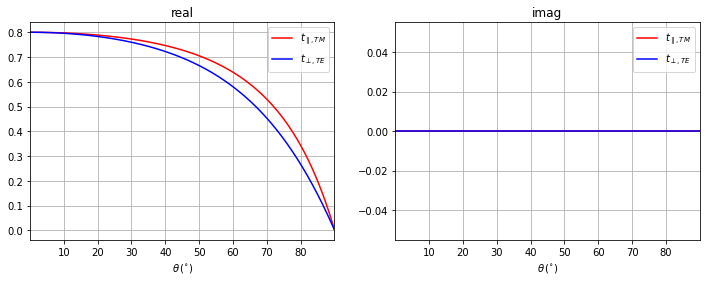

We can se Brewster angle.
1.2.2. \(n_2 < n_1\)
[6]:
t_TM, t_TE, r_TM, r_TE = fresnel_equations(
    theta, wavelength, n1, n2, has_draw=True, kind="real_imag"
)

T_TM, T_TE, R_TM, R_TE = transmitances_reflectances(
    theta, wavelength, n1, n2, has_draw=True
)


1.2.3. \(n_2 > n_1\)
Here total internal refraction is clear. i nthe amplitude/phase representation.
[7]:
t_TM, t_TE, r_TM, r_TE = fresnel_equations(
    theta, wavelength, n2, n1, has_draw=True, kind="amplitude_phase"
)
T_TM, T_TE, R_TM, R_TE = transmitances_reflectances(
    theta, wavelength, n2, n1, has_draw=True
)


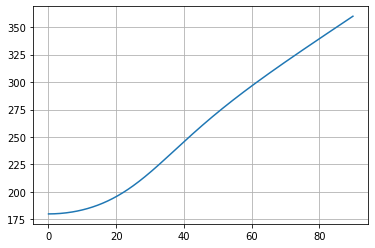
Phase difference between the two polarizations
[8]:
plt.plot((np.angle(r_TE) - np.angle(r_TM)) / degrees)
plt.grid()

1.2.4. \(n_2 = n + i \kappa\)
This case is when the second medium present a complex refractive index, as in metals.
[9]:
t_TM, t_TE, r_TM, r_TE = fresnel_equations(
    theta, wavelength, n1, n2c, has_draw=True, kind="real_imag"
)
T_TM, T_TE, R_TM, R_TE = transmitances_reflectances(
    theta, wavelength, n1, n2c, has_draw=True
)


Phase difference between the two polarizations
[10]:
plt.plot(theta / degrees, (np.angle(r_TE) - np.angle(r_TM)) / degrees)
plt.grid()

1.2.5. \(n_1 = n + i \kappa\)
This case is more strange, as the first medium is complex, it absorbs the light field, but it may be interesing when it is a thin metallic layer.
[11]:
n2c = 1 + 1j
[12]:
t_TM, t_TE, r_TM, r_TE = fresnel_equations(
    theta, wavelength, n2c, n1, has_draw=True, kind="real_imag"
)
T_TM, T_TE, R_TM, R_TE = transmitances_reflectances(
    theta, wavelength, n2c, n1, has_draw=True
)
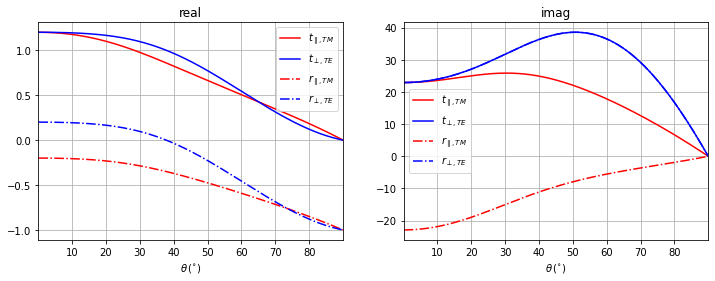
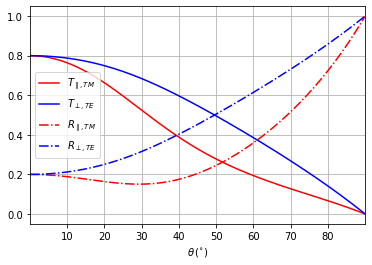
Phase difference between the two polarizations
[13]:
plt.plot(theta / degrees, (np.angle(r_TE) - np.angle(r_TM)) / degrees)
plt.grid()